Choosing an implementation partner for gateway course reform, including corequisite support, starts with one question: A year from now, will your institution have made real changes to placement, schedules, courses and advising, or will it only have held meetings? For US college and university leaders weighing outside support for gateway courses, five criteria separate an implementation partner from an advisory firm:
- Built from practice: the partner’s team has done this work on campuses, not only studied it.
- Alongside your team: it works inside your task force and carries project management, rather than reporting and leaving.
- Outcomes, not activities: it can show outcome data from institutions like yours.
- Culture, systems and classroom together: it addresses all three at once.
- A concrete first year: it can describe what will be different in one year.
Across more than 100 partnerships, Almy Education has found that most institutions reach scale within that year.
In this guide
- What implementation support means in higher education
- How implementation partners differ from advisory and consulting support
- The most common mistake in choosing an implementation partner
- What implementation support includes in practice
- The Gateway Success at Scale framework: culture, systems and classroom
- Coreq 1.0 and Coreq 2.0: how the partner’s job changes
- What a scope of work for implementation support should include
- Five criteria that separate an implementation partner from an advisory firm
- Twelve questions to ask any implementation partner
- How to tell whether you bought outcomes or activity
- What the first year with an implementation partner should look like
- Red flags and pitfalls when choosing an implementation partner
- How Almy Education supports gateway course and corequisite implementation
- Frequently asked questions
Key takeaways
- Choosing an implementation partner for gateway course reform comes down to five criteria: experience built from practice, work alongside your team, outcomes over activities, culture, systems and classroom together, and a concrete picture of the first year.
- Implementation support is embedded, accountable, faculty-partnered work that turns decisions into practice. Strategy, network and advisory partners help an institution decide what could be done; an implementation partner also helps it get done.
- Coreq 1.0 institutions need a partner who can build corequisite support. Coreq 2.0 institutions, already at scale with uneven results, need one who diagnoses the schedule, access and advising before anything else.
- A strong first year leaves artifacts on campus: a heat map of offerings, a project plan with named owners, updated advising and registration practice, and a dashboard of leading indicators.
- The test a year later is simple. An institution that can only say it met once a month bought activity. One that can name redesigned courses, trained faculty, aligned advising and a launch date bought outcomes.
What implementation support means in higher education
Implementation support in higher education is an embedded, hands-on partnership that helps a US college or university move a gateway course reform from decision to consistent practice within an academic year. An implementation partner turns decisions into a student experience that works before, during and after the gateway course, which takes coordinated work across placement, advising, scheduling, registration, communications, curriculum and student support. Almy Education works as an implementation partner for gateway course redesign, joining an institution’s task force as a member focused on execution rather than a distant advisor.
Implementation support should provide project management and accountability, so leaders know the project is still moving and someone is minding the store. A partner who is basically a resource, a live version of Google that answers questions only when asked, is not where an institution should invest its limited resources.
Implementation support should feel like someone is in the weeds with you, not at a distance waiting for you to send updates or raise problems. The partner works hand in hand with you as another member of your task force. If you have to summon them for help, that is not implementation support.
In practice, an implementation partner works across placement, scheduling, advising, registration, web communications and faculty coordination at the same time, rather than in silos. It turns policy decisions into intake scripts, registration defaults, web language and staff routines, runs project management with clear owners, timelines and dependencies, improves the work term over term, and leaves tangible artifacts such as heat maps, decision logs and dashboards. It does not offer one-off training that expires when the consultant leaves, recommendations without follow-through, classroom-only work that ignores the systems around instruction, or engagements that advise and leave.
How implementation partners differ from advisory and consulting support
Implementation partners differ from strategy partners, networks and advisory firms in one way that matters to a Chief Academic Officer (CAO), Vice President of Academic Affairs (VPAA) or provost choosing outside support for gateway course reform: they help the institution do the work, not only decide what the work should be. Strategy and frameworks can tell a campus what could be done. Implementation support helps it get done, at the right pace and in the right order.
| Advisory or network services | Traditional consulting | Implementation partnership | |
|---|---|---|---|
| Primary focus | Knowledge sharing and frameworks | Analysis and recommendations | Decisions put into practice, and the outcomes they produce |
| Typical activities | Webinars and convenings on corequisite design | A gateway math redesign report | Building and iterating the corequisite syllabus with faculty |
| What it delivers | Research summaries and guides | Recommendations and a final report | Artifacts the campus uses: heat maps, project plans, decision logs, advising guides, dashboards |
| Who does the work | The institution alone | The institution, on the consultant’s advice | The institution and the partner together. The partner carries project management and accountability; ownership stays on campus |
| Time with the campus | Virtual, quarterly | Occasional site visits | A standing cadence, weekly or monthly |
| How progress is measured | Participation | Deliverables completed | Leading indicators during the term, and student outcomes by term |
| What lasts after it ends | Notes from sessions | The report | Routines, decision records and owners that persist |
| First-term change | Awareness | A plan document | An action plan with dates, and artifacts already in use |
A strong implementation partner also knows how much information to share. The aim is enough to support confident decisions without overwhelming the team. Almy Education describes it as a dance: judging, at each step, whether the team needs more information or less, so leaders feel good about the choices they are making.
The difference shows up in results. Advisory partners work at a high level and offer broad suggestions. Implementation partners help an institution make specific decisions and then carry them out in daily practice, across every office that touches the student experience.
The most common mistake in choosing an implementation partner
The most common mistake US colleges and universities make in choosing an implementation partner for corequisite and gateway course reform is hiring a partner who works on one part of the student experience, such as faculty development, tutoring or making the case for reform, when results depend on the whole of it.
Case-making, the research, examples and convenings that make the case for a reform, has real value, but it does not change practice on its own. When a case-making engagement ends, an institution often faces the gap it started with: a decision may exist, but daily practice has not changed.
Placement shows why. Suppose an institution decides that high school GPA will be the default placement method. That decision only takes effect when intake steps change, advisors have new scripts, every student-facing web page stops sending students to placement testing “just in case,” and registration defaults route students correctly without manual workarounds. If those changes do not happen, the policy exists, but students still experience the old system.
The distance between “we’ve decided to do corequisites” and corequisite support working predictably in every section is the implementation gap. A partner who works on only one part of the student experience cannot close it, because the gap sits between the parts. The result is inconsistency: one advisor explains corequisite support accurately while another steers students elsewhere, and one registration pathway defaults to concurrent enrollment while another needs a manual override.
What implementation support includes in practice
Implementation support in practice means a partner who sits in the standing meetings of an institution’s gateway course task force, facilitates decisions, tracks action items between meetings and clears blockers. The style that works is respectfully directive: a partner who listens and includes faculty, advisors and administrators, and still sets the cadence, the urgency and the next steps, so that a provost or VPAA feels held rather than carrying the daily work of worrying about the project.
Strong implementation support co-creates the artifacts the work depends on: project charters, implementation timelines, draft policies, course templates, communication plans and marketing materials. It brings faculty, staff and students into design decisions, which builds shared ownership and reduces resistance, and it is how institutional gateway course transformation with faculty buy-in happens. The partner manages the changes under way, so the work runs more smoothly and feels less difficult for the people carrying it.
This is time and energy intensive work, but there’s no replacement for the human element. No software or cohorted meeting can replace the small, nuanced conversations with the right faculty, advisors and administrators at the right time, often before or after meetings or in small side conversations. That is where change and implementation happen.
Implementation support also has to reach every layer of the work: state alignment, institutional policy, program-level pathways and the practice in each section.
The Gateway Success at Scale framework: culture, systems and classroom
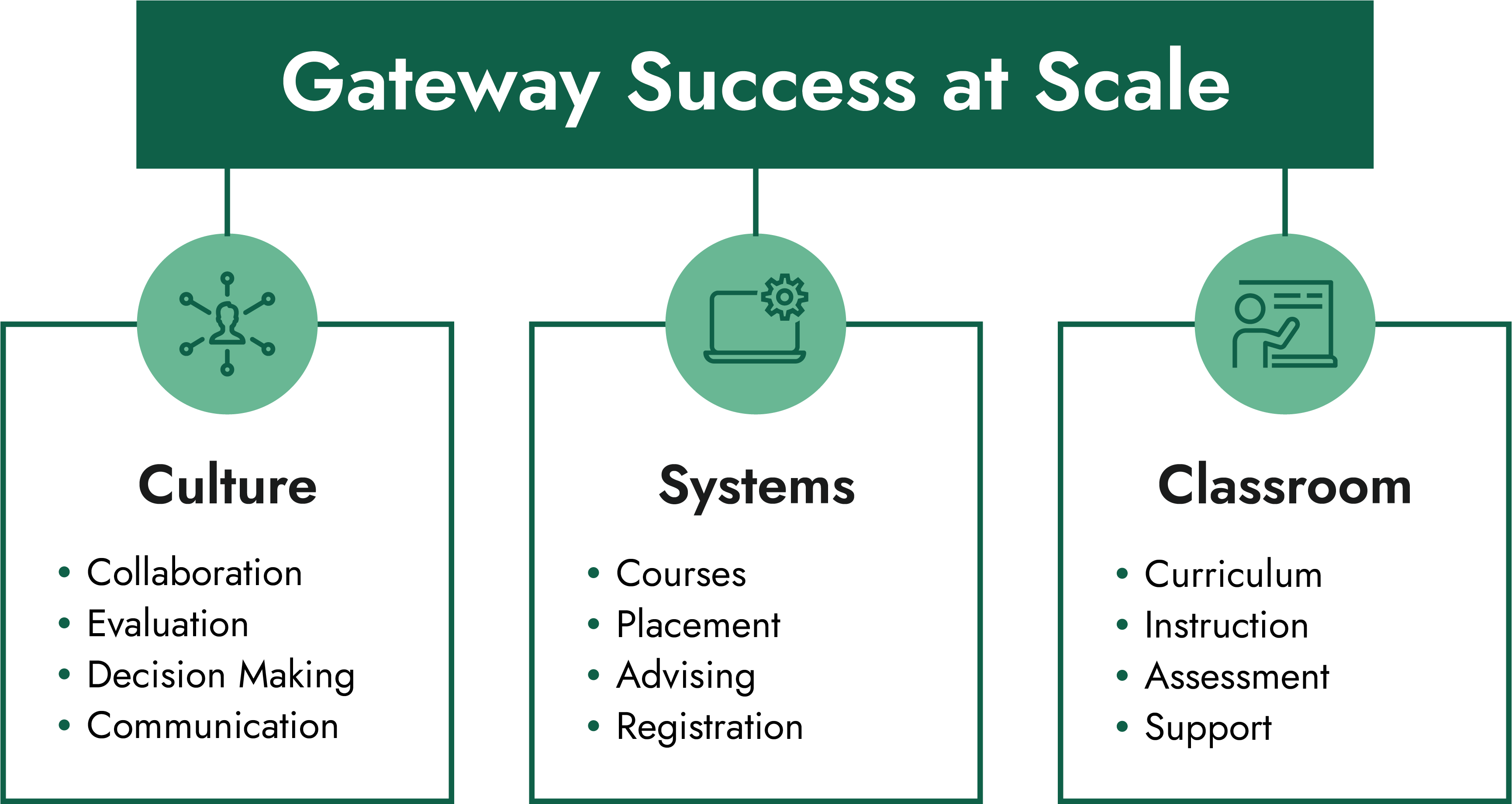
Almy Education anchors every implementation partnership in Gateway Success at Scale, a framework built for gateway course reform at US colleges and universities. It holds that sustainable improvement requires aligned changes across three areas, Culture, Systems and Classroom, and that institutions which address all three in the right order reach measurable scale, not isolated pilots.
Culture: faculty-partnered, practitioner-led change
Culture is the foundation of gateway course reform. It is how faculty, staff, students and leadership collaborate and make decisions, and it determines whether any change effort takes root. Without cultural readiness, improvements to systems and classrooms do not stick.
Culture work at Almy Education is cross-functional. It brings academic administrators, faculty leaders from each discipline, and leaders in advising, registration and institutional research to the same table, and faculty take part as partners in redesigning corequisite support. Key elements include:
- A core team, with dedicated people in key positions to support implementation and coordinate the work
- Norms and decision rules created together
- Representation from every group the change touches
Almy Education brings a team of specialized consultants who are current or former faculty and understand shared governance. Visible outcomes include faculty-owned course shells and peer-led professional learning plans by a defined term.
Systems: placement, advising, scheduling and registration aligned
Systems are the structural layer of gateway course reform: placement, advising, scheduling, registration, pathways, and the policies that determine whether students are in the right course at the right time. Aligning these systems is what allows a successful pilot to become institutional practice.
Concrete systems changes include updated placement rules, registration process changes, scheduling patterns that make corequisite enrollment possible, advising workflows that match the new model, and data dashboards focused on completion rates. Almy Education’s “done with you” project management means mapping current and future processes, writing the procedures together, launching in the targeted term and refining practice based on evidence. Teams finish with standard operating procedures for term-to-term scheduling and early-alert escalation.
Classroom: co-designed courses, supports and assessments
Classroom is where transformation becomes visible: curriculum, pedagogy, assessment and corequisite support, redesigned collaboratively by Almy Education’s consultants and institutional faculty, producing the measurable changes in student outcomes that justify the investment.
Almy Education supports faculty in co-designing syllabi, content, corequisite labs, just-in-time support materials and assessments aligned to course outcomes. Almy Education’s Classroom work brings evidence-based strategies, refined through partnerships with more than 100 colleges and universities, into every redesign, and adapts them with each institution’s faculty to its own courses and students. Examples include a common corequisite College Algebra course shell for STEM programs aligned with state transfer expectations, and an integrated reading and writing corequisite for English Composition. The goal is coherent course structures and teaching practice that last beyond the partnership.
Coreq 1.0 and Coreq 2.0: how the partner’s job changes
Corequisite support at US colleges and universities is at one of two stages, and the right implementation partner depends on which. Coreq 1.0 institutions are building corequisite support for the first time or scaling it beyond pilots. Coreq 2.0 institutions already run corequisite courses at scale, but their results have plateaued or vary by section, term or student group.
Coreq 1.0: building corequisite support
A Coreq 1.0 institution needs a partner who can build the operating structure for corequisite support from the start. The work includes:
- Schedule design that makes it possible to enroll in the gateway course and its support in the same term
- Placement rules that route incoming students using multiple measures
- Advisor preparation, so advisors can explain the corequisite model and recommend it with confidence
- Decision rights that make clear who decides what, and by when
Coreq 2.0: at scale, with results that have plateaued
A Coreq 2.0 institution already offers corequisite courses in gateway math and English, and sometimes in biology or chemistry, but its results have plateaued or vary widely. It needs a partner who can diagnose where the system broke down and rebuild the routines around it:
- Retiring legacy options. Many institutions added corequisite courses without removing the standalone developmental courses that compete with them, so a schedule audit comes first.
- Iteration routines, so sections that struggle get targeted help within the term
- Consistency, so a student’s experience does not depend on which advisor they see or which section they enroll in
- Leading indicators, tracked during the term rather than only at its end
A partner who is strong at a Coreq 1.0 build may lack the diagnostic depth a Coreq 2.0 reset needs, and a partner who specializes in Coreq 2.0 iteration may overbuild the work for an institution that is just beginning. Almy Education’s article on Coreq 2.0 sets out what that stage involves.
Three corequisite checks for any partner
Three checks apply when the work is corequisite support at a US college or university, whatever stage the institution is at.
- Discipline coverage. Can the partner support corequisite redesign beyond math and English, in biology, including anatomy and physiology, and in chemistry?
- Faculty development for both instructors. Can the partner help gateway course instructors and corequisite support instructors plan together, so the support connects to what happens in the college-level course?
- A realistic timeline under a mandate. Where a state policy sets the deadline, can the partner show a plan that meets it inside your academic calendar, including curriculum approval cycles?
Read more about Almy Education’s corequisite support implementation.
What a scope of work for implementation support should include
A scope of work for implementation support in gateway course or corequisite reform should name five things: the deliverables, the cadence, the artifacts the campus will own, how accountability works, and a dated timeline. A strong partner helps an institution make decisions in the right order, with the dependencies in place, so the work does not stall or have to be redone later.
- Deliverables: a heat map of current offerings and where students get stuck; a project plan with tasks, owners, timelines and dependencies; a decision log with decision rights and escalation paths; a dashboard of leading indicators; updated placement and prerequisite policies; and common course outlines or shells for corequisite sections.
- Cadence: a standing operating routine with task owners, regular readouts for the provost or VPAA, and term-over-term reviews of outcomes by section and student group.
- Artifacts the campus owns: registration default documentation, intake script templates, advisor quick-reference guides, faculty onboarding guides, dashboard views by cohort, section and term, and curriculum maps showing where corequisite support connects to the course. Each is dated and versioned, with an owner on campus, so the work does not stall when the engagement ends or a champion leaves.
- Accountability: a named owner for every deliverable, decision deadlines, escalation when departments disagree, and documented dependencies between offices.
- Timeline: milestones at one month, one term and one year. Vague phases such as “assessment” followed by “implementation” signal a framework, not an implementation plan.
Leaders should judge implementation support by what it produces over the first 3 to 12 months, not by hours logged or workshops held. Artifacts should be usable, not slide decks. Almy Education’s engagements leave institutions with their own templates, advisor checklists and data tools. Our case studies show the results from our partner institutions.
Five criteria that separate an implementation partner from an advisory firm
Five criteria separate an implementation partner from an advisory firm, and they apply to any firm an institution is considering, Almy Education included. They are written for college and university leaders in the United States weighing outside support for gateway courses in math, English and the sciences, including corequisite support. For each criterion, the table shows what to look for and the evidence to ask for. Judge a partner on the evidence it can show, not on its description of itself.
| Criterion | What to look for | Evidence to ask for |
|---|---|---|
| 1. Built from practice | The people who will work on your campus have taught gateway courses and led implementation at other institutions | Examples of implementations the team has led, and an institution you can talk to |
| 2. Alongside your team | A named place on your task force, project management, and a cadence you can predict | A sample project plan and meeting rhythm, and who tracks action items between meetings |
| 3. Outcomes, not activities | Results stated as changes in gateway outcomes, with the measurement window | Pass rate, DFW rate and throughput figures from comparable institutions, and a reference you can call |
| 4. Culture, systems and classroom together | A scope that covers placement, scheduling, advising and registration as well as curriculum and faculty | A scope of work that addresses all three areas, and examples of the artifacts it produces |
| 5. A concrete first year | A plausible account of what will be launched, redesigned and trained within a year, and what you will own when the engagement ends | A dated plan for the first term and first year, with named deliverables and owners |
Throughput is the share of students who complete their first college-level gateway course within their first year.
Twelve questions to ask any implementation partner
These twelve questions help a CAO, VPAA or provost test whether a firm offering implementation support for gateway course or corequisite reform can actually deliver it. Ask them of every partner you are considering. The answers that matter are specific: named people, real artifacts, dates and disciplines.
- Who does the work, and who advises? A strong answer names the people who will do the work and the implementations they have led.
- What will you deliver in the first 30 days, and who on our campus will own each item? A strong answer names a heat map of current offerings, a baseline, and a team and decision structure, each with an owner.
- How do you turn a decision into daily practice? A strong answer walks through an example, such as a placement decision traced through intake scripts, web pages, registration defaults and advising.
- What does your operating routine look like, and who takes part? A strong answer describes a standing cadence, meetings that end in decisions and owners, and people from advising, the registrar, institutional research and the departments.
- Can you show us artifacts from past engagements? A strong answer includes anonymized heat maps, decision logs, project plans and course shells, not descriptions of what the partner would create.
- How do you work through disagreement between departments, and within shared governance and collective bargaining? A strong answer describes escalation paths, work through existing committees, and timelines set to curriculum approval cycles.
- What leading indicators will you track, and how often? A strong answer names enrollment into support, registration completion, early attendance and use of support, reviewed during the term rather than after it.
- How do you support disciplines beyond math and English? A strong answer describes work in biology, including anatomy and physiology, and in chemistry, with examples.
- Tell us about a Coreq 2.0 institution whose results had plateaued. What did you change first? A strong answer starts with the schedule, access and advising before it turns to teaching.
- What happens when the engagement ends, or when a key person on our team leaves? A strong answer includes documented routines, owners and a sustainment plan, so the work does not depend on one champion.
- A year from now, what will be different, and how does that fit our academic calendar? A strong answer describes a plausible one-year arc: what will be launching, what will already be redesigned, and what training and advising preparation will be under way. A weak answer is vague, names no concrete changes and cannot say what is feasible in a year.
- Is there another institution we can talk to where you have done this work and it has worked? A strong answer offers references at comparable institutions, and case studies of that work.
Ask for sample artifacts, such as anonymized implementation plans and course templates, rather than slide decks, and expect answers specific to your disciplines and type of institution.
How to tell whether you bought outcomes or activity
The simplest test of an implementation partnership for gateway course reform is what a college or university can say a year after it began. If the institution can only say that the team met once a month, it bought activity. If it can say that the course redesign is complete, faculty training is under way, advising is aligned with the new pathways and launch is near, it bought outcomes. Meetings, professional development and conversation are not the goal of implementation support. Movement is. Support focused on outcomes produces changes leaders can see: decisions that have been put into practice, clear differences in placement, schedules, courses and advising, and steady progress toward launch and scale. The same test works before a contract is signed. Ask each partner what your institution will be able to say a year from now, and judge the answer by how concrete it is.
What the first year with an implementation partner should look like
The first year of an implementation partnership for gateway course reform at a US college or university should produce visible progress on campus, not only planning. Implementation work runs on the academic calendar: teams are on the clock during the term and hard to convene outside it, so a real implementation plan sets its cadence and deliverables around those windows.
Month 1: diagnose and align
The first month of an implementation partnership puts the right cross-functional team and decision structure in place, sets a baseline of gateway outcomes and equity gaps, and audits the schedule to build a heat map of what is actually offered and where students get stuck. It also surfaces quick fixes that show momentum, such as removing conflicting web language or correcting a registration default.
By day 30, the institution should have a heat map of current offerings and student routing, a baseline metrics document, a map of who is involved with their decision rights, and a plan for the quick fixes.
Months 2 to 4: decide and build
In months two to four, intake messaging, registration defaults and advisor scripts are updated and the decision log is started. A Coreq 1.0 institution also prioritizes one or two gateway disciplines, agrees its placement policy and course flowchart, builds a schedule model for corequisite sections and drafts early syllabi or course shells.
By the end of the first term, the institution should have updated intake scripts and advisor guides, documentation of its registration defaults, a standing operating routine and the first entries in its decision log. If by 90 days all you have are meeting notes and slide decks, you are not receiving true implementation support. There should be institutional artifacts that can survive leadership transitions.
Months 4 to 12: operationalize and sustain
In the rest of the first year, the dashboard of leading indicators goes live, tracking enrollment, registration completion, early attendance and use of support. Iteration routines bring problems in individual sections to the surface and fix them within the term, readouts for institutional leadership become regular, and a sustainment plan documents the routines and artifacts so the work outlasts the engagement.
By the end of the first year, the dashboard should be in use, the first readouts delivered, the iteration routine documented and the sustainment plan drafted. Time with the implementation partner should make your team’s time count. If your team has to hold another meeting on its own to work out what to do next, or the partnership only adds time to what you are already doing, it is not the right support model.
Where a Coreq 2.0 diagnosis starts
At a Coreq 2.0 institution, where corequisite courses already run at scale, the first diagnosis checks access before teaching:
- Start with the schedule. Identify what is offered and whether students can get into corequisite support without friction.
- Check that students can see it. Review the website, the schedule and student-facing messages to confirm students can tell the support exists.
- Remove hoops first. Find every barrier to enrollment and remove the biggest ones immediately.
- Add enough sections. Make sure there is enough support capacity for students to enroll right away.
- Align advising and messaging. Standardize how advisors describe the option and present it in plain language. Students do not need the term “corequisite”; describe it as a support class built into their week.
- Listen. If access and visibility look fine, ask advisors, deans and students how the support is being received.
- Run a short anonymous survey. Ask three or four questions, such as “Is this [specific change] meeting your needs?” and “Would you want more of this support or less of it?”
Red flags and pitfalls when choosing an implementation partner
Watch for these eight warning signs when evaluating an implementation partner for corequisite and gateway course reform at a US college or university, whether in a proposal or a first conversation.
- Advice at a distance. The partner waits to be called and has to be chased for help.
- Activity without movement. Meetings are the main output, and teams need their own meetings afterwards to work out what to do.
- Case-making only. Proposals lean on research and “best practices” with no operational detail, and the partner will not make a recommendation.
- One slice of the student experience. The proposal covers curriculum and instruction with no attention to placement, scheduling and advising, or the reverse. Language that treats faculty as the problem, rather than as partners, is a warning sign too.
- A generic scope. The scope is the same for Coreq 1.0 and Coreq 2.0, with no schedule audit and no diagnosis specific to your institution.
- No concrete first year. There are no milestones at one month, one term and one year.
- Accountability gaps. There are no named owners, the measurement plan is vague, and success is counted in activities delivered.
- Pilots with no route to scale. The work runs through isolated pilots with no plan for scale.
Three other pitfalls recur: scheduling and registration complexity is underestimated, adjunct faculty who teach many gateway sections are left out of onboarding, and placement and advising practice stays the same after the policy changes. An implementation partner reduces these risks by sequencing the work, naming owners and building routines across academic affairs, advising, IT and institutional research, drawing on tailored solutions for higher ed transformation.
How Almy Education supports gateway course and corequisite implementation
Almy Education is an implementation partner for gateway course redesign and corequisite support at US colleges and universities, with more than 100 college and university partnerships and approximately 75 current clients. Almy Education is led by a team that brings deep expertise in both subject matter and institutional change management, and it is the only consultancy with a team of specialized consultants who are current or former faculty.
Institutions typically come to Almy Education at one of three points:
- They have adopted corequisite policies but are not seeing the throughput they expected
- They are preparing for a statewide mandate
- They want to scale gateway course outcomes across disciplines: math, English, biology (including anatomy and physiology), and chemistry
In Almy Education’s “done with you” model, the team joins your gateway task force, co-leads design sessions, owns parts of the project plan, and transfers tools and methods to your internal leads. Services include Gateway Course Redesign, Corequisite Support Implementation, Curriculum Design and Development and Higher Education Transformation Consulting for broader system alignment.
Almy Education’s implementation partnerships are structured to meet all five criteria above. Most institutions reach scale within one year.
A first conversation covers where your institution is now, Coreq 1.0 or Coreq 2.0, the early gaps across offices, what a year could accomplish, and a candid view of fit. Use the criteria and questions above in every partner conversation, whether with us or anyone else.
Frequently asked questions
What is the difference between an implementation partner and a consultant?
A consultant in higher education usually analyzes a problem and recommends what to do, and the institution carries out the recommendations on its own. An implementation partner does that analysis too, then works alongside the institution’s team to carry the work out: running the project plan, keeping decisions moving, producing the artifacts and helping get the work across the finish line. For gateway course reform, the difference shows a year later in what has changed in placement, schedules, courses and advising. Learn more about Almy Education’s higher education transformation consulting.
What does an implementation partner do for corequisite reform?
For corequisite reform, an implementation partner turns a policy decision into a student experience that works before, during and after the gateway course. That means reviewing what the schedule actually offers, aligning placement rules, registration defaults and advising scripts with the new model, helping gateway and support instructors plan together, and tracking leading indicators so sections that struggle get help within the term. At Coreq 2.0 institutions, the first step is usually the schedule, which often shows legacy course options still running alongside corequisite support.
How long does an implementation partnership for gateway courses last?
Meaningful scaled change rarely fits into a single term. Most institutions reach scale within one year, and many plan an implementation partnership for 12 to 18 months spanning at least two major terms. A common pattern is intensive design and early implementation in the first 6 to 12 months, followed by refinement, scaling to additional disciplines, and building internal capacity in the second year. The length depends on institutional size, the number of disciplines in scope, and whether the work is at a single campus or across a system.
How is implementation support funded, and how do institutions structure budgets?
Funding for implementation support often comes from institutional student success budgets, state allocations tied to gateway reforms, Title III and Title V grants, or philanthropic initiatives focused on equity and completion. Many colleges structure implementation partnerships across fiscal years aligned to major terms, planning an initial intensive phase followed by a lighter sustainment phase. An implementation partner should help scope the work to your budget, focusing first on the outcomes and disciplines with the most impact, such as gateway math and English. The partner should help you accomplish as much as is feasible for your institution in the time available, not extend the engagement with little visible progress.
Can implementation support work in unionized and strong shared-governance environments?
Yes. Implementation support can work in unionized and strong shared-governance environments, but the approach matters. Effective implementation support respects existing governance structures, including academic senates, department councils and collective bargaining agreements. Almy Education’s practitioner-led team works through existing committees, sets timelines that align with curriculum approval cycles, and supports faculty leaders in bringing proposals through formal channels. This approach builds legitimacy and reduces the risk that reforms are seen as imposed from outside.
What internal roles does implementation support need?
Implementation support for gateway courses needs a senior sponsor (the CAO, VPAA or provost), a day-to-day project lead such as a dean or director, department chairs or course coordinators in the gateway disciplines, representatives from advising, the registrar, IT and institutional research, and faculty design teams. An implementation partner does not replace these roles; it coordinates and strengthens them through shared routines and tools. Almy Education helps institutions define these roles clearly at the start of an engagement.
How can we tell if we are ready to engage an implementation partner?
An institution is ready to engage an implementation partner when it has a clear commitment to improving gateway outcomes and equity, policy decisions on corequisites or placement made or pending, and at least some dedicated time from key leaders. Institutions do not need fully formed plans or their own project management capacity first. If an institution has already implemented corequisites, Almy Education meets the institution where it is, without starting over. A short conversation about your current gateway data, policy environment and timelines can clarify readiness and scope.
Choosing an implementation partner is a decision about what your institution will be able to say a year from now. If you’d like to talk through where your gateway courses stand, schedule a conversation with our team.