Corequisite support works by pairing a college-level gateway course with a support course or support time that students take in the same term, so they earn college credit from the first day instead of finishing a developmental sequence first. At US colleges and universities, the support has one job: helping students succeed in the college-level course they are taking now. It does not reteach a list of high school topics. A typical session checks what students are missing, teaches the skill the next lesson needs or skills missing related to topics already covered, builds study habits, bridges to college-level problems, and gives guided practice on the course's own work. The two courses are aligned, scheduled together, and graded so they do not compete for students' time, and the support is sized as support, not as a second full course. Done well, it is easy to find in the class schedule and easy to register for.
How a corequisite course is structured
A corequisite course at a US college or university pairs two things in the same term: the college-level gateway course and the support attached to it. The support is its own course or its own block of time, and its only purpose is the student's success in the college-level course. That purpose is the whole of what corequisite support is, and everything else about the structure follows from it.
The most common reason a corequisite does not succeed is that it is not built as support. Many are developmental courses tacked onto the college-level course, or old developmental courses compressed into less time, still carrying their old list of topics and sized like a second course. A support course is sized as support. It adds what the college-level course needs that week and no more, and the first thing to check at an institution whose corequisites are underperforming is whether the support is a support course at all.
The two courses are scheduled together. The support meets alongside the college-level course, in the same part of the week, not on a separate day when every other class runs Monday to Thursday. The students get registered into it without hoops. If enrolling in the support takes a special advising appointment or a separate registration step, the support is hidden from the students who need it, and that is not a strong implementation. Black Hawk College linked registration so that the support section and the college-level section share a section number, with a "C" designation marking the corequisite pair, as part of the first stage of the college's corequisite work.
A corequisite term from week one to finals
A corequisite term at the college level is planned backward from the college-level course, one week at a time. The instructor looks at the whole college-level course and its goals, then works backward to decide what the support will do each week of the semester. Every week asks the same question: what makes this week's unit or topic in the college-level course hard, and what support addresses it this week, while it matters.
The moves repeat each week even as the content changes. Assess what students need more instruction on. Give that instruction where it is needed. Give student success support. Scaffold from where students are to where the course needs them to be, with activities that take them there. Then let them apply it to the course's own work, whether that is a math problem, a paper, or a problem set in a science course.
Non-cognitive support runs all term, not just in week one and not just in test weeks. The habits that get students through a college-level course, showing up, doing the work, and following through, need attention every single week to the end of the term.
There is room for flexibility in all of this, but the time has to be intentional throughout the semester. The alternative is a rut: students come in, the instructor asks what questions they have, answers them, and the hour ends. Students stop attending a course like that. A short weekly check keeps the plan honest: exit tickets or a low-stakes quiz tell the instructor what next week's support should carry, and a check with students around the fourth week asks whether the course is working for them while there is still time to change it.
Inside a corequisite support session
A corequisite support session at the college level follows a loose, repeatable structure, and most of its time is students working, not listening. Almy Education structures the session in five parts.
| Part | What it is for |
|---|---|
| Assess | Find the gaps or misconceptions that matter for this week's work |
| Teach | Address the key prerequisite skill the next lesson needs |
| Equip | Build student success habits |
| Scaffold | Connect to college-level content, for example through a bridge problem |
| Apply | Practice on the college course's own work |
The scaffold step is where the session crosses into college-level work. Bridge problems and scaffolded activities move students from where they are to college-level problem solving, so the support is neither a developmental lesson nor a second run at the lecture but a bridge between the two. Almy Education creates corequisite materials, including bridge problems, for client institutions as part of corequisite support implementation, so faculty are not building every session from scratch, and has partnered with over 100 college and university clients on corequisite support in math, English, and the sciences, including biology, chemistry, and anatomy and physiology.
A good corequisite classroom is often loud. Students are talking to each other, working at the board, and working in pairs; the instructor is talking, and the students are talking too. What the session should not become is more lecture, a homework hour, time on the computer, or a recitation. That drift happens when instructors have had little guidance on how to use the time, and it is the surest sign that a corequisite has room to improve. The full session plan, with timings and example activities for each part, is in the corequisite implementation field guide.
Grading and workload in a corequisite course
Grading and workload in a corequisite course at the college level should push students toward one goal: passing the college-level course. Support that piles on its own assignments and its own grading competes with the college-level course, and students no longer know where to spend their time. A well-designed corequisite does not make students choose. It only helps them pass the college-level course, and students engage with it because it meets their needs; there is something in it for them.
That means lightweight assessment: brief quizzes rather than tests, no duplicated work, and assignments aligned so a student never has to decide between corequisite homework and college-level homework. It means grading that rewards the behaviors that drive success, such as attending the support, engaging with the content and with peers, and making progress in the college-level course. And it means common practices across sections, with room for each instructor's style. Not everyone has to teach identically, but everyone teaching a corequisite on the same course works from a shared approach that keeps the goal of the corequisite in view, rather than each heading in their own direction and hoping to arrive at the same place.
How the support differs by subject
Corequisite support at US colleges and universities follows the same structure in every subject, but what it focuses on depends on the course. In an algebra-based math course, the biggest problem is usually students remembering their algebra, so the support rebuilds the algebra the course uses, in the way the course uses it. In a non-algebra math course such as statistics, quantitative reasoning, or liberal arts math, the biggest problem is usually readiness for college-level expectations, so the support focuses on mathematical thinking and the student success habits that carry a course: getting assignments done, showing up, following through.
In English, corequisite support uses the same five parts, applied to making sense of a text or writing something rather than solving a problem. Reading and writing are integrated, and developmental reading support is embedded in the composition course in the context where it is used, rather than in a standalone reading course. In the sciences, the clearest case is chemistry: where a math prerequisite once stood, a focused math-for-chemistry corequisite teaches the math the way chemistry uses it. In biology and the other sciences, most of the work is the design of the college-level course itself; how corequisite support differs across math, English, and the sciences is set out in the guide for leaders.
How to tell a corequisite course is working
A corequisite course at a US college or university that is working shows it in who signs up, who keeps coming, and what students say. Students can find the support and get registered into it, and it is described to them simply, as a support class, extra help built into their week with a teacher, rather than with a term they have to look up. Students keep coming back because the time helps; if it feels like busy work, more assignments, or an hour that does not meet their needs, they vote with their feet and stop attending.
A good corequisite is easy to sell to students, to faculty, and to staff. It is easy to find on the class schedule, support is widely available, many students are in it, and students who are not required to take it ask whether they can join. A check with students around week four, asking whether the support course is working for them, confirms what attendance already suggests. Colleges that have offered corequisites for years without the results they expected are the case moving from corequisite access to predictable gateway success at scale describes. For the measures a college tracks across the whole program, from throughput to equity gaps, see measuring corequisite success in the guide to corequisite support at scale.
Frequently asked questions
Do students take the corequisite and the college-level course in the same term?
Yes. That is what makes it a corequisite. Students enroll in the college-level gateway course from the first day and take the support alongside it in the same term, earning college credit immediately rather than after finishing a developmental sequence. Support that ends partway through the term or is front-loaded before a late-starting term is not corequisite support; it is still using the concept of prerequisites.
How should a corequisite support course be scheduled?
Alongside the college-level course, in the same part of the week, so the two feel like one experience. It should not sit on a separate day from everything else, and it should be sized as support rather than as a second full course, adding what the college-level course needs that week and no more.
How do students register for a corequisite course?
Easily. Students should not need a special advising appointment or a separate registration step to get into the support. Linked registration, as at Black Hawk College, where the support section and the college-level section share a section number, lets a student enroll in both at once.
What happens in a corequisite support session?
The session follows five parts: assess what students are missing, teach the skill the next lesson needs or the previous lesson used, equip students with success habits, scaffold with a bridge problem into college-level work, and apply it to the course's own assignments. Most of the time is students working, and a good session is often active and loud.
How is a corequisite course graded?
So that it never competes with the college-level course. That means brief quizzes rather than tests, one aligned set of assignments rather than duplicated work, and grading that rewards attendance, engagement, and progress in the college-level course.
How can a college tell its corequisite courses are working?
Students can find the support in the class schedule and get registered into it easily, they keep attending because the time helps, and students who are not required to take it ask to join. A check with students around week four, asking whether the course is working for them, catches problems while there is still time to adjust.
Field guide
The corequisite implementation field guide
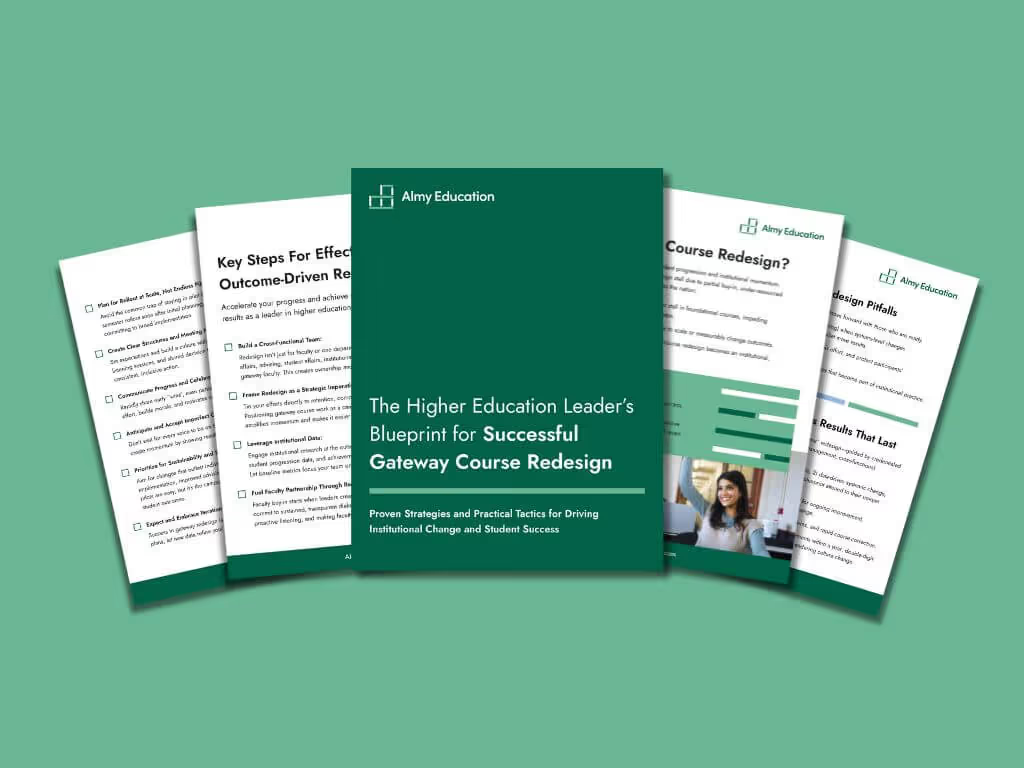
The full session plan, with timings and example activities for each part, is in the corequisite implementation field guide, a free download.
Download the field guide